


It’s easy to look at modern vehicles and assume that they have only been around a few decades, at most. In reality, however, when looking at something like a used Chevy Suburban, you can go back nearly 100 years and find a Suburban available. The Chevy Suburban is actually the longest-running model in the industry since it goes all the way back to 1933 and has been available every year since without interruption. That being said, the Suburban that first hit the road in the 1930s was more than a little different than the one we have available today, although not quite as different as you might expect.
Today, we thought it would be fun to take a look at the earliest models of the Chevy Suburban, as well as the most recent 2021 model, and see how they compare. We’ll tell you right now: there are some massive differences here, especially when it comes to performance. As you might expect, engines and other technology have come a long way in the last almost-90 years, and modern vehicles offer power that would’ve been unimaginable in the 1930s. But there are a few surprising similarities between these vehicles divided by such a long span of years.
The 1933 Chevy Suburban
To start with, let’s go all the way back to 1933 and the very first Chevy Suburban model, which was a far cry from the SUV we know today. That being said, if you saw this vehicle on the road, you’d probably call it an SUV, though it also looked quite a bit like a large station wagon. It was designed as competition to wagons being built by other manufacturers at the time, like Studebaker and Dodge, which is why it has the general look and feel of a large wagon.
The original 1933 Suburban featured mostly wood construction – the body was mainly made of wood and certainly doesn’t match what we expect from a vehicle today. That wooden body was built on a half-ton truck frame, much the same as modern SUVs (remember that crossover models are built on a car platform rather than a truck). So decades before the term “Sport Utility Vehicle” was being used, that’s exactly what the original Suburban was: an SUV. It was a large model with enough interior space for up to eight passengers, but it was not designed for use by the general public.
This original Suburban was meant for use by the Civilian Conservation Corps and the National Guard. So while this is officially the first Suburban, it wasn’t the first available for consumer sale. Similarly, the 1934 model was not generally available to the public, but it introduced a sheet metal body rather than the mostly wooden body of the 1933 model. It was known as the “Carryall Suburban” and featured a rear tailgate, not entirely unlike modern SUVs.
The 1935 Chevy Suburban
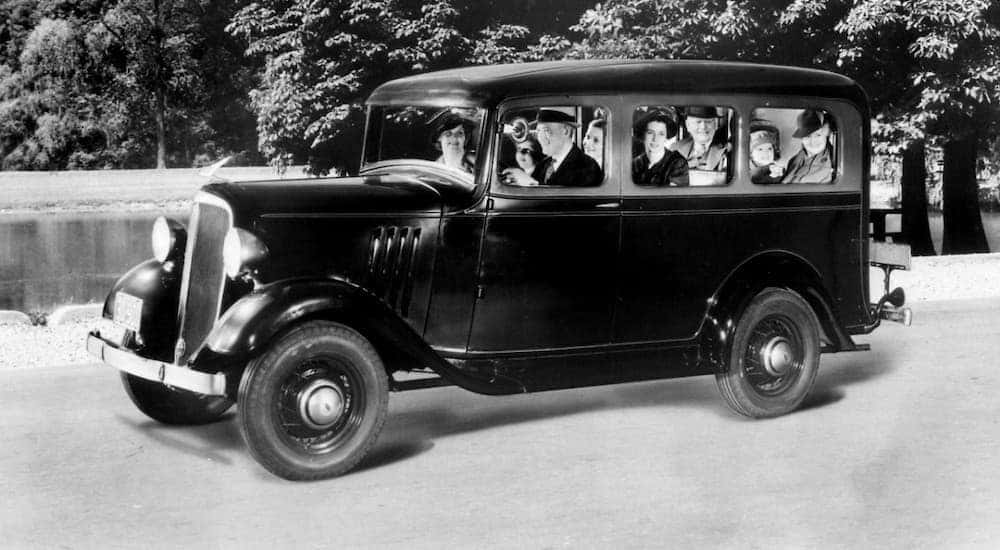
While the Suburban got its start in 1933, the 1935 model is considered by many to be the true first generation for the Suburban since this was when it started being produced and intended for sale to the general public. The functionality and benefits of such a large vehicle became clear pretty quickly, and the Suburban of the 1930s was just as popular with big families as the Suburban of the 2020s is today. Just like the previous models, the 1935 Suburban had seating for up to eight people: three in the front, two in the middle row, and three more in the rear seats.
One of the things that made this such a functional vehicle is that many of these seats were designed to be removable. So if you had a relatively small family of four, you could load up everyone and everything you needed for a picnic or weekend away with the kids. But you could also have plenty of seating for a night out with friends or social groups, making it very attractive to drivers in the 1930s. While a lot of the Suburban’s competitors still had mostly wooden bodies, the 1935 model retained its steel construction.
In terms of power, the Suburban of this time was impressive for its day, though it would not exactly be considered a beast now. The 1935 Chevy Suburban featured a 207 cu.in. (that’s about 3.4L) engine with an I-6 design (called the Blue Flame Six) that delivered up to 80 hp. Yes, that’s right: this light truck with seating for eight people could get up to 80 hp. Like we said, not exactly a powerhouse by today’s standards, but it did the trick 80+ years ago.
The 2021 Chevy Suburban

So how does all of that compare to the modern Chevy Suburban – or even a very recent used Chevy Suburban that you might find at a dealership? Well, let’s look at the 2021 model to fully appreciate just how far the Suburban has come. The 2021 Chevy Suburban is a large SUV, which is built on a truck platform just like its ancestors nearly 90 years ago – like we said, some things haven’t changed all that much.
It has seating for up to nine people these days – at least some models do; some have seating for eight or seven people instead. Depending on the trim and options you look at, a modern Suburban might have three rows of three-person seating, or a pair of front seats with two rows of three-person bench seats behind, or captain’s chairs in the front and second row, with a third-row bench seat. These seats can be lowered or even removed in some cases, giving you a ton of interior cargo space or passenger space – much like the original Suburban.
Perhaps the most noticeable change compared to the 1935 model is the engine (we’ll get to some tech features that would’ve been unimaginable 86 years ago in a moment). The modern Chevy Suburban has three different engines available, all of which are just slightly more powerful than that old Blue Flame Six. The standard engine is a 5.3L V8 that delivers up to 355 hp, while an available Duramax 3.0L Turbo-Diesel offers up to 277 hp and 460 lb-ft of torque. Finally, an available 6.2L V8 engine provides an impressive 420 hp, with a 10-speed automatic transmission that gives you a smoother drive than the manual on the 1930s I-6.
And of course, there’s all the technology that you’ll find in the 2021 Chevy Suburban. Every model comes with a 10-inch Infotainment display standard, with an available 8-inch digital driver information center, available 15-inch head-up display projected onto the front windshield, and an available Bose 10-speaker CenterPoint surround sound system. Remember that the first demonstrations of early televisions were in the 1920s. In 1933, people still primarily listened to radios at home, and color movies were barely even a thing – The Wizard of Oz was still 6 years away.
The idea of multiple HD displays and information projected onto the windshield would’ve been quite literally inconceivable to drivers at the time. Not to mention seatbelts, airbags, and active safety features like automatic emergency braking, rear park assist, and front pedestrian braking, all of which are standard on the 2021 Suburban. We’ve certainly come a long way.
Jump Behind the Wheel of History
Whether you’re interested in the latest model or prefer the idea of a used Chevy Suburban, we can help you find it. A 1933 model might be out of our reach, but come visit us for something a bit more modern. When you get behind the wheel of a Chevy Suburban of any year, you are getting behind the wheel of history in a vehicle that has seen the evolution of features and capability and still made it through. Visit us today and see what models of the Suburban we have in stock, test drive your favorites, and see why the Chevy Suburban has been able to persevere and stay in the hearts of drivers for almost 90 years.
Connect with us


- May 2024
- April 2024
- March 2024
- February 2024
- January 2024
- December 2023
- November 2023
- October 2023
- September 2023
- August 2023
- July 2023
- March 2023
- February 2023
- January 2023
- December 2022
- October 2022
- September 2022
- August 2022
- July 2022
- June 2022
- May 2022
- April 2022
- February 2022
- September 2021
- August 2021
- July 2021
- June 2021
- May 2021
- April 2021
- March 2021
- February 2021
- January 2021
- December 2020
- November 2020
- October 2020
- September 2020
- August 2020
Archives
- Buick Dealer
- Buick Dealer Near Maysville
- Buick Dealer Near Winchester
- Car Maintenance
- Certified Pre-Owned Vehicles
- Chevrolet Trucks
- Chevy Blazer for Sale
- Chevy Dealer
- Chevy Dealer in KY
- Chevy Dealer Near Charleston
- Chevy Dealer Near Huntington
- Chevy Dealer Near Louisville
- Chevy Dealer Near Maysville
- Chevy Dealer Near Me
- Chevy Dealer Near Winchester
- Chevy Equinox for Sale
- Chevy Equinox For Sale Near Louisville
- Chevy EV
- Chevy EV Dealer In Lexington
- Chevy Features
- Chevy Silverado 1500 for Sale
- Chevy Silverado 1500 for Sale Near Bardstown
- Chevy Silverado 1500 for Sale Near Huntington
- Chevy Silverado 2500 for Sale
- Chevy Silverado 2500 for Sale Near Charlestown
- Chevy Silverado for Sale
- Chevy SUVs
- Customized Vehicles
- Electric Vehicles
- Employee Spotlights
- Gasoline
- Kentucky Chevy Dealer
- Kentucky Used Car Dealership
- Kentucky Used Car Lot
- Lexington
- Lexington Silverado Dealer
- Lexington Used Car Dealer
- Lexington Used Truck Dealership
- Liquid Diamond
- Local
- New Cars In Stock Near Me
- New Vehicle
- New Vehicles For Sale
- Priced Under 10k
- Supercar
- Used Auto Dealer in Lexington
- Used Buick Dealership
- Used Buick Dealership Near Lexington
- Used Car Dealership
- Used Chevy Dealership
- Used Chevy Dealership Near Carlisle
- Used Chevy EV
- Used Chevy Silverado
- Used Chevy Silverado 1500 For Sale
- Used Chevy Silverado Dealer in KY
- Used Chevy Silverado for Sale
- Used Chevy Suburban
- Used Chevy Tahoe
- Used Chevy Traverse
- Used Chevy Trax for Sale
- Used Chevy Trucks Near Me
- Used Dealership Near Versailles
- Used Diesel Trucks
- Used Jeep Wrangler
- Used Luxury Vehicles for Sale
- Used Minivan Dealer
- Used Truck Dealer
- Used Truck Dealer in Kentucky
- Used Truck Dealer in Lexington
- Used Trucks for Sale Near Me
- Used Vehicles For Sale